Christmas Cupcake Embroidery Review
As an embroidery designer who has spent years translating digital concepts into tangible, stitched realities for small businesses, I approach every new design file with a critical eye. We are not just looking at aesthetics; we are evaluating scalability, stitch integrity, and brand alignment. Today, I am reviewing the Christmas Cupcake design, a piece described as keeping you in good spirit throughout the winter holidays. While the description invites you to stitch this adorable motif on a favorite sweater, my focus is strictly on its viability for commercial application, branded merchandise, and professional patch work.
First Impressions: Personality and Visual Impact
The title "Christmas Cupcake" immediately suggests a blend of festive cheer and culinary warmth. From a design perspective, this combination offers a unique opportunity for brands that want to appear approachable yet professional. The word "adorable" in the product description hints at a softer, perhaps rounded silhouette, which is excellent for creating a friendly brand identity but requires careful execution to avoid looking too childish for certain B2B or high-end retail contexts.
In the current market, consumers are drawn to handmade aesthetics even when purchasing mass-produced items. A well-executed embroidered patch featuring a cupcake motif can bridge the gap between artisanal charm and corporate polish. It feels playful without being chaotic, making it suitable for a wide range of industries, from bakeries and cafes to creative agencies looking for holiday-themed swag.
Real-World Business Applications
Let us look at how this machine embroidery design performs when applied to actual business assets. The versatility of a cupcake motif allows it to function effectively across multiple touchpoints:
- Staff Uniforms and Aprons: For boutique cafes, patisseries, or food trucks, this design serves as a perfect chest logo accent. It humanizes the staff and instantly communicates the nature of the business. When embroidered on a high-quality canvas apron, it adds a layer of custom apparel value that customers appreciate.
- Branded Patches: This design translates exceptionally well to iron-on or sew-on patches. Small business owners often use these for inventory tagging, customer service badges, or limited-edition merchandise. The circular or contained nature of a cupcake shape usually works well within standard patch dimensions.
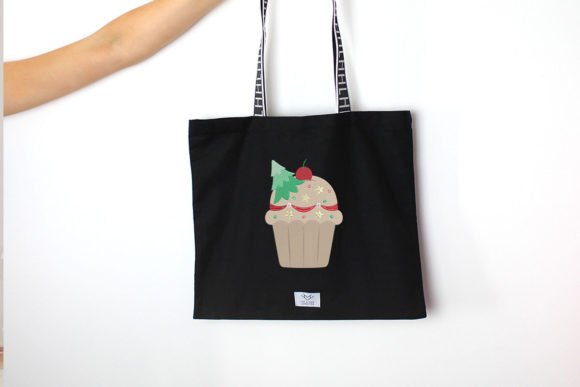
- Holiday Merchandise: For Etsy sellers and craft business assets, this design is a goldmine for Q4 sales. Think tote bag designs for holiday markets, cap embroidery for seasonal promotions, or even accents on gift boxes. It acts as a visual cue for the season without overwhelming the brand’s core identity.
- Product Packaging Accents: Imagine a sticker backing or a small label on a jar of homemade jam or cookie mix. A tiny, precise embroidery digitization (or a printed equivalent mimicking embroidery) can elevate the perceived value of the finished product.
Evaluating Brand Identity and Customer Trust
Using the Christmas Cupcake design strategically impacts how your audience perceives your brand. Consistency is key in building trust. If your brand voice is warm, welcoming, and slightly whimsical, this design reinforces that message. However, if your brand is strictly minimalist or luxury-focused, you must ensure the design does not clash with your existing design assets.
When executed correctly, such details enhance brand identity by adding a personal touch. Customers remember the feeling of receiving a gift with a thoughtful, custom detail. It signals that you care about the presentation, which directly influences buyer engagement and repeat purchases.
Technical Considerations and Risk Management
Not all designs are created equal, and as a designer, I must highlight where this specific motif might face challenges in production. The success of any digital embroidery file depends heavily on technical execution.
Size and Detail Constraints
If you plan to use this as a small patch size or a subtle sleeve detail, you must scrutinize the stitch density. Intricate outlines around the frosting or sprinkles can become muddy if the stitches are too close together on small areas. Conversely, if the spacing is too wide, the image may lose definition. Always test the design at 50% and 75% of its intended final size to ensure legibility.
Furthermore, consider the fabric texture. On coarse burlap or highly textured wool, fine details may disappear. On smooth cotton or polyester blends, the design will pop. Be cautious with dark uniforms; unless you use a high-contrast thread color palette and proper underlay stitching, the design may lack visibility.
Stitch Density and Stability
High stitch density can cause puckering, especially on lightweight fabrics used for tote bag design or thin caps. Ensure that the digitizer has accounted for proper stabilizer usage. For curved surfaces like the front of a baseball cap, the design must be balanced to prevent distortion during the hooping process. If the design relies on tiny lettering for text (such as "Merry Christmas"), verify that the font width is sufficient for machine readability.
Practical Designer Notes for Production
Before committing this embroidery file to large-scale production, follow these essential steps to mitigate risk and ensure quality:
- Black and White Test: Convert the design to grayscale first. This helps you evaluate the contrast and balance of shapes without the distraction of color choices.
- Fabric Swatch Testing: Never run a full production batch without testing on the actual fabric you intend to use. Check for thread breaks, tension issues, and how the stabilizer interacts with the material.
- Thread Color Contrast: Review the thread colors against your brand guidelines. Do they align with your visual consistency? Sometimes, a change in thread shade can make a design look premium or cheap.
- Hoop Size Verification: Confirm the required hoop size matches your available equipment. Large designs may require multi-hooping, which increases production time and potential misalignment.
- Create a Printable Mockup: Use software to create a realistic mockup for client approval. This allows stakeholders to visualize the finished product on actual merchandise before cutting fabric.
- Commercial Licensing: Most importantly, confirm commercial licensing terms. Just because you bought the file does not always mean you have the right to sell products bearing the design. Ensure you are protected legally.
Final Verdict
The Christmas Cupcake design holds significant promise for small business owners looking to add festive flair to their small business merch. Its strength lies in its ability to convey warmth and professionalism simultaneously. However, its success depends entirely on technical diligence. By paying attention to stitch density, fabric choice, and proper stabilization, you can transform this adorable motif into a powerful tool for brand recognition.
For boutiques, cafes, and creative studios, this design offers a cost-effective way to boost holiday sales and employee morale. It is not just a decoration; it is a strategic asset. Evaluate it against your other design assets, test it rigorously, and if it fits your brand narrative, it could become a staple in your seasonal collection. Remember, in the world of embroidery, the devil is in the details—so inspect every stitch before you ship.